6. Product Thinking and Metrics
Data science only creates value when it improves a decision. That is why product and business context matter. A technically correct analysis can still be low-value if it optimizes the wrong behavior or ignores important trade-offs.
Start with the decision
Before choosing metrics, ask:
- who is the user or stakeholder
- what behavior are we trying to change
- what business or operational outcome matters
- what harms or costs must be avoided
Metrics make sense only after those questions are answered.
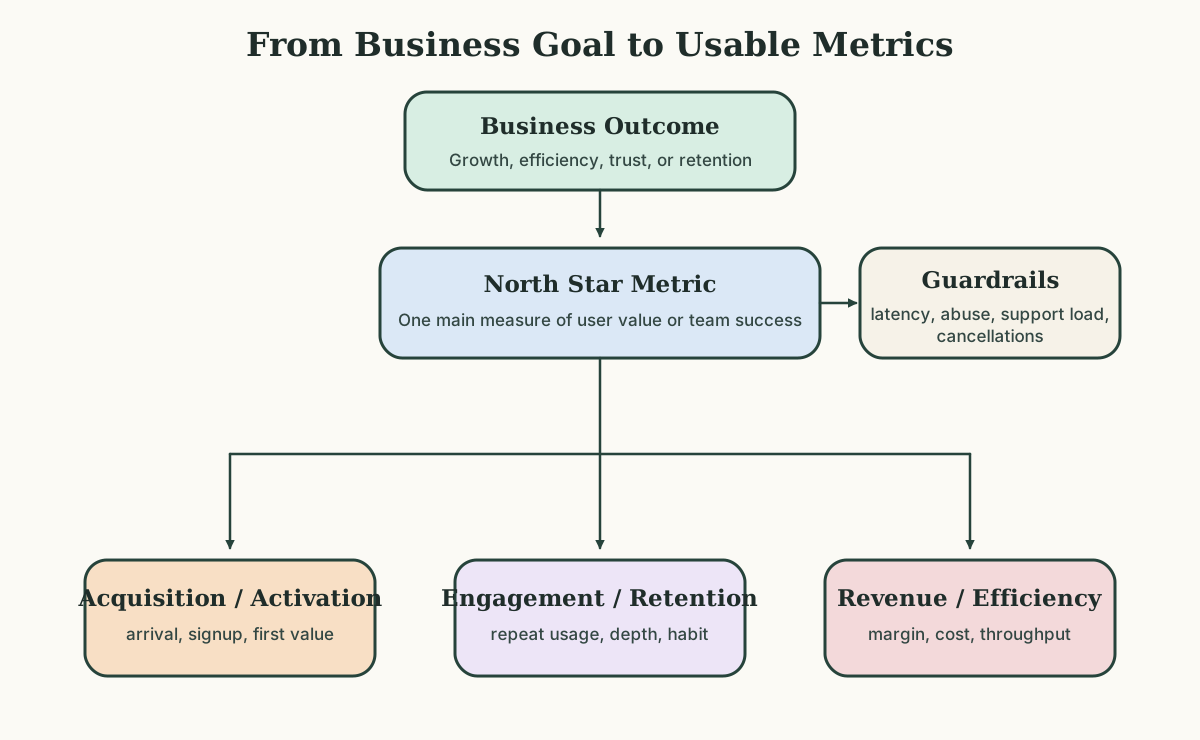
A practical metric ladder
Many products can be understood through a flow like:
- acquisition: are new users arriving
- activation: do they reach first value
- engagement: do they use the product meaningfully
- retention: do they come back
- revenue or efficiency: does the business sustain the experience
Not every team uses the same labels, but the underlying logic is common.
North star metrics and guardrails
A north star metric summarizes the main outcome the team is trying to improve. Guardrails protect against winning the headline number by damaging something else.
Examples of guardrails:
- latency
- support burden
- cancellation rate
- abuse or fraud
- margin or cost per action
What makes a metric bad
| Bad metric pattern | Why it fails |
|---|---|
| easy to move but weakly tied to value | encourages local optimization |
| ambiguous denominator | becomes easy to misread or game |
| impossible to explain to stakeholders | reduces trust and adoption |
| measured too late for iteration | slows learning |
Diagnosing a metric change
When a metric moves unexpectedly, do not jump straight to storytelling. Start with checks:
- did the definition or logging change
- did the denominator change
- did composition shift across segments, geographies, or channels
- was there a product launch, experiment, outage, or seasonality effect
- did countermetrics move in the opposite direction
Most real diagnosis work is part statistics, part product understanding, and part data quality investigation.
Business sense is part of metric sense
If you do not understand how the organization creates value, you will struggle to choose high-leverage metrics.
Ask:
- how does the product make money or reduce cost
- where are the bottlenecks
- what behaviors are leading indicators versus lagging outcomes
- what trade-offs are acceptable or unacceptable
Chapter takeaway
The right metric is not the one that sounds sophisticated. It is the one that best connects user behavior, business value, and operational safety.
Next: End-to-End Case Thinking.