Start Here
This handbook is for the first stage of becoming useful on a data science team.
The goal is not to memorize every method. The goal is to become the kind of teammate who can frame a problem clearly, work with real data carefully, and communicate a recommendation that people can act on.
What data scientists actually do
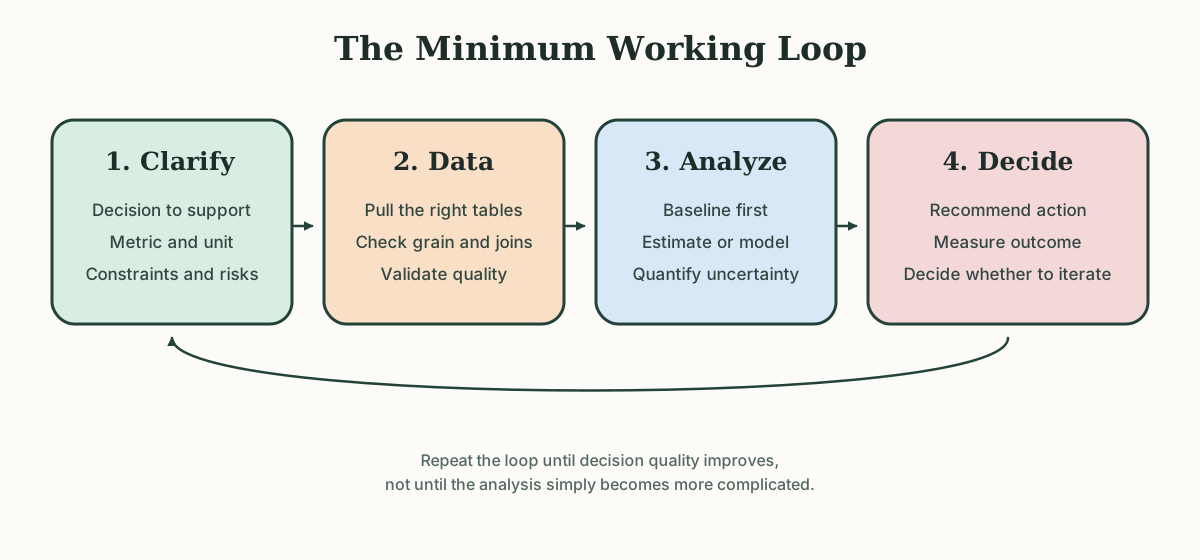
Titles vary from company to company, but most data science work falls into a few recurring loops:
- define the decision or question
- retrieve and validate the relevant data
- analyze patterns or build a model
- recommend an action and measure what happens next
What good early-career judgment looks like
At this stage, strong judgment usually looks like:
- asking what the unit of analysis is before writing the query
- checking whether a reported lift is statistically and practically meaningful
- building a strong baseline before reaching for a more complex model
- noticing leakage, missingness, duplication, or metric-definition problems early
- explaining trade-offs instead of pretending there is a perfect answer
What this handbook leaves out on purpose
To keep the material focused, this handbook does not try to cover:
- measure-theoretic probability
- advanced deep learning architectures
- causal inference in depth
- distributed systems internals
- the full landscape of modern ML research papers
Those topics matter, but they are not the minimum bar for getting started well.
The four habits to build first
- Be precise about definitions.
- Prefer trustworthy baselines over flashy complexity.
- Treat uncertainty as part of the answer, not an inconvenience.
- Tie every analysis back to a real decision.
A simple self-check
Before moving on, make sure you can answer these questions:
- Can I explain what a row in a dataset represents?
- Do I know the difference between correlation, prediction, and decision-making?
- Am I comfortable saying “I need to check the assumptions behind that number”?
If yes, continue to Probability and Uncertainty.