2. Statistics and Experiments
Statistics is how we turn noisy samples into defensible claims. In applied data science, that usually means estimating uncertainty, testing ideas carefully, and deciding whether an observed change is worth acting on.
Sampling variability is the default
Two samples from the same process will not look identical. That is normal, not a bug.
This is why data scientists need more than point estimates. A metric without uncertainty can be actively misleading.
Law of large numbers and central limit theorem
The law of large numbers says that sample averages stabilize as sample size grows.
The central limit theorem says that, under common conditions, the sampling distribution of the sample mean becomes approximately normal as the sample gets large enough:
That approximation powers confidence intervals and many standard hypothesis tests.
Important caveat: the CLT is not magic. Heavy dependence, extreme tails, or tiny samples can make the approximation poor.
Confidence intervals
A confidence interval gives a plausible range for an unknown parameter:
The practical purpose is not ritual. It is to show both effect size and uncertainty in the same answer.
Hypothesis testing
The usual workflow is:
- state a null and alternative hypothesis
- choose a test statistic
- compute a p-value or confidence interval
- compare the evidence with your decision threshold
What a p-value does mean:
- how surprising the observed result would be if the null model were true
What a p-value does not mean:
- the probability that the null hypothesis is true
- the probability that the result will replicate
- proof that the effect matters in practice
When to use a z-test versus a t-test
Two common test statistics for mean comparisons are the z-test and the t-test. They are closely related, but they are not interchangeable in every setting.
Use a z-test when:
- the sampling distribution is approximately normal and the population variance is known
- or the sample is large enough that the standard normal approximation is acceptable
- or you are working with proportions, where z-based approximations are common in large-sample experiments
Use a t-test when:
- you are testing a mean and the population variance is unknown
- the sample is not especially large and the data are approximately normal
- you estimate uncertainty using the sample standard deviation rather than a known population value
The main idea is simple:
- z-tests treat the scale of uncertainty as known
- t-tests account for the extra uncertainty from estimating that scale from the sample itself
That is why the t-distribution has heavier tails than the standard normal. It is more cautious, especially in smaller samples.
In formulas, the classic one-sample statistics look like:
where
In practice:
- for many large-scale online experiments on proportions, z-based tests are common
- for smaller-sample mean comparisons, t-tests are usually the safer default when normality is a reasonable approximation
- as sample size grows, the t-test and z-test often become numerically very similar
One important caveat is that the classical small-sample t-test relies on the underlying variable being approximately normally distributed. If the sample is small and the data are strongly skewed, heavy-tailed, or dominated by outliers, a t-test may not be reliable.
The main mistake to avoid is using a t-test as an automatic default for any small sample. In small samples with doubtful normality, a transformation, permutation test, bootstrap procedure, or a suitable nonparametric method may be more defensible.
Type I error, Type II error, and power
- Type I error: false alarm
- Type II error: missed real effect
- Power: probability of detecting a real effect of meaningful size
Good experimentation is not only about keeping Type I error small. It is also about making sure the experiment is capable of detecting the effect size you actually care about.
A/B testing as a disciplined workflow
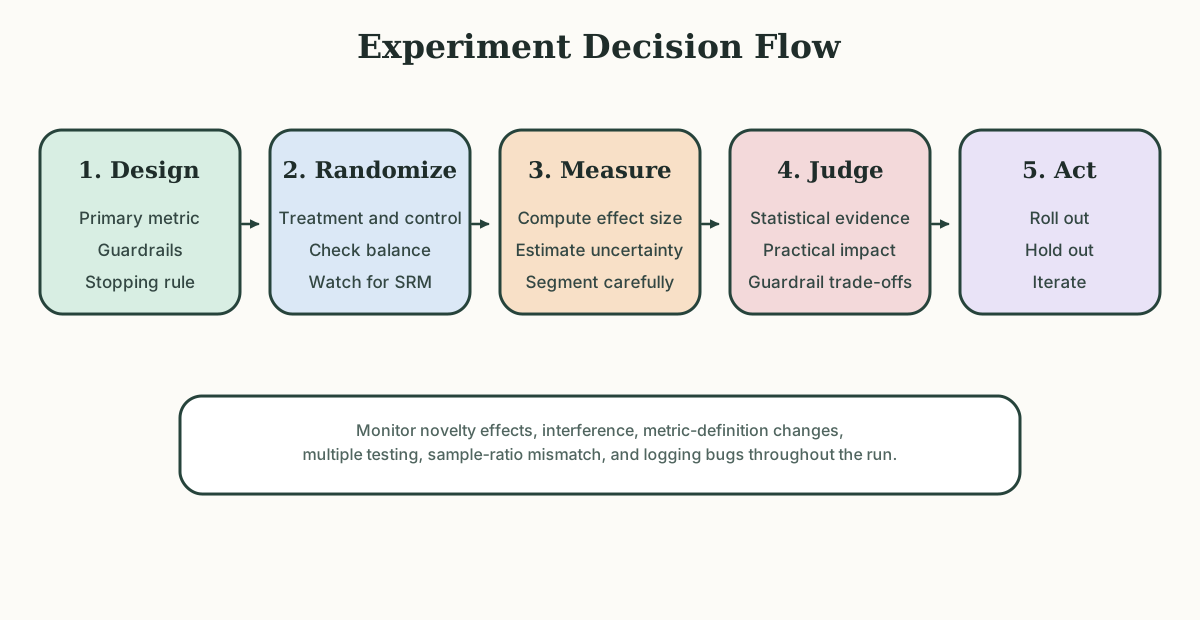
In product and growth settings, the most common experimental pattern is randomized comparison between treatment and control.
For a difference in proportions, a common standard error is:
That estimate helps you judge whether a measured conversion lift is large relative to ordinary noise.
Sample size requirements and minimum detectable effect
Before launching an experiment, you should ask a simple question:
- how much traffic do we need before this test can realistically detect an effect we care about?
That is a sample-size question. If the experiment is too small, even a real improvement may look indistinguishable from noise.
The key inputs are:
- significance level
- desired power, often
- baseline rate or variance
- the minimum detectable effect (MDE), meaning the smallest effect worth detecting
The MDE is especially important. If you set it too small, sample requirements can become impractically large. If you set it too large, the test may miss effects that actually matter.
For a balanced two-group experiment on a proportion metric, a common rough approximation for the required sample size per group is:
where:
This formula captures the main intuition:
- smaller effects need much larger samples
- noisier metrics need larger samples
- higher confidence and higher power both require more data
As a concrete example, a 0.2 percentage-point lift can require far more traffic than a 2 percentage-point lift, even when everything else stays the same.
Practical sample-size guidance
- decide the MDE from business value, not wishful thinking
- estimate sample size before launch instead of after seeing weak results
- remember that guardrail metrics often need their own power analysis
- expect segment-level reads to need much more traffic than the headline result
In practice, sample size is part of experiment design, not a formality. It determines whether the test can answer the question it was meant to answer.
What to decide before launching an experiment
- the unit of randomization
- the primary success metric
- guardrail metrics such as latency, cancellations, abuse, or support load
- the minimum effect size worth shipping
- the analysis window and stopping rule
If these are vague before launch, the interpretation often becomes vague after launch too.
Check balance, watch for SRM, and use A/A tests
Before reading outcome metrics, make sure the experiment itself looks healthy.
Start with balance checks. In a randomized experiment, treatment and control should look similar on important pre-treatment variables such as geography, device mix, historical activity, or prior spend. A small imbalance can happen by chance, especially in smaller samples, but a systematic pattern is a warning sign.
What balance checks are good for:
- catching broken randomization or eligibility logic
- spotting exposure definitions that accidentally exclude some users
- finding logging problems that affect one arm more than the other
Use judgment here. If you test many covariates, some will differ just by randomness. The goal is not to demand a perfect match on every column. The goal is to notice patterns that are too large or too consistent to ignore.
One especially important check is sample ratio mismatch (SRM). If a test was designed for a 50/50 split, but the observed exposed traffic is much closer to 57/43, that is often a stronger warning than any movement in the business metric.
A common diagnostic statistic is:
where
SRM often points to one of these problems:
- assignment or bucketing bugs
- eligibility filters that differ by arm
- delayed or missing exposure logs
- user flows where one group drops out before measurement
When SRM appears, pause before interpreting lift. If the traffic split is not trustworthy, the effect estimate usually is not trustworthy either.
An A/A test is another useful diagnostic. In an A/A test, both groups get the same experience, so any measured difference should be explainable by ordinary noise.
Why A/A tests help:
- they validate the randomization and exposure pipeline
- they reveal whether metric definitions are stable
- they show whether false positives are appearing too often
- they give a reality check on the variance assumptions used in power calculations
An A/A test is most useful when you are launching a new experimentation framework, changing logging, or introducing an especially important metric. It is less useful as a ritual before every small feature test.
Common mistakes in real experiments
| Failure mode | Why it matters |
|---|---|
| peeking too early | repeated looks inflate false positives unless handled correctly |
| multiple testing | some “wins” appear by chance when enough metrics or variants are checked |
| sample ratio mismatch | traffic allocation, exposure logging, or eligibility rules may be broken |
| novelty effects | short-term excitement may not represent steady-state behavior |
| interference | one user’s treatment can affect another user’s outcome |
Bonferroni correction and multiple testing
If you test many hypotheses at once, the chance of at least one false positive rises. That is why a result can look significant in one metric or segment even when nothing real changed.
The Bonferroni correction is the simplest adjustment:
where
For example, if you want a family-wise error rate of
You can think about it in two equivalent ways:
- divide the acceptable error budget by the number of tests
- or multiply each p-value by the number of tests and compare the adjusted value to the original threshold
Why this matters in experimentation:
- comparing many product metrics increases the chance of a spurious win
- slicing results across many segments can create noisy “discoveries”
- testing many variants at once makes naive interpretation too optimistic
The main downside is that Bonferroni is conservative. It reduces false positives, but it also makes real effects harder to detect, especially when the number of tests is large or when many tests are correlated.
So the practical rule is:
- use Bonferroni when the number of tests is modest and you want a simple, cautious adjustment
- avoid treating it as a substitute for pre-registering a primary metric and limiting unnecessary comparisons
Worked example: an e-commerce checkout conversion test
Suppose an online retailer wants to test a simpler checkout page. The product team believes fewer form fields will reduce friction and increase completed purchases.
Here is a practical end-to-end setup:
| Decision | Example choice |
|---|---|
| business question | does a simpler checkout increase completed orders? |
| unit of randomization | eligible checkout sessions |
| primary metric | purchase conversion rate |
| guardrails | average order value, payment failure rate, page latency |
| planned split | 50 percent control, 50 percent treatment |
| baseline conversion | 10 percent |
| minimum detectable effect | 0.8 percentage points |
| significance and power |
Using the rough sample-size formula from above with
Before trusting any lift, the team should confirm the experiment is healthy:
- the observed traffic split is close to the intended 50/50 allocation
- pre-treatment covariates such as device mix and returning-user share look broadly balanced
- the exposure log fires consistently for both arms
Assume the launch passes those checks and the experiment runs until each group reaches 24,000 sessions.
| Group | Sessions | Purchases | Conversion |
|---|---|---|---|
| control | 24,000 | 2,400 | 10.0 percent |
| treatment | 24,000 | 2,640 | 11.0 percent |
The estimated lift is:
or 1.0 percentage point.
Using the standard error for two proportions:
so the z-statistic is:
That is strong evidence against the null of no difference. A rough 95 percent confidence interval is:
So the likely true lift is somewhere between about 0.45 and 1.55 percentage points.
Now the team should ask the second question: is the effect large enough to matter?
If the company gets 2 million eligible checkout sessions per month, a 1.0 percentage-point lift translates to about 20,000 additional monthly orders. If average order value and payment failure rate stay stable, the test may be worth shipping. If the treatment raises conversions but also increases refunds, customer complaints, or latency, the decision becomes less obvious.
This example ties together the main experimentation ideas:
- define the metric and guardrails before launch
- power the test around a meaningful MDE
- check balance and SRM before reading lift
- use the effect size, uncertainty, and business impact together
- avoid celebrating noisy wins from many unplanned segment cuts
Statistical significance is not business significance
With large enough sample sizes, tiny effects can look statistically convincing while still being irrelevant to the business. The reverse can also happen: a meaningful effect may fail to reach significance because the experiment was underpowered.
Good judgment requires both questions:
- Is the signal real enough?
- Is the signal large enough to matter?
Chapter takeaway
A strong data scientist does not treat statistics as ceremony. They use it to separate noise from signal, and to avoid making confident decisions from fragile evidence.
Next: Machine Learning Essentials.