4. Customer Value, Acquisition, and Marketing ROI
The fourth session shifts attention from platform structure to measurement. Once a platform has some traction, it has to answer a different set of questions: which customers are valuable, which acquisition spend is truly incremental, and how much of observed growth is actually caused by marketing?
4.1 Customer lifetime value is about contribution over time, not signup counts
The notes define customer lifetime value, or CLV, as the expected profit generated by a customer over their relationship with the platform. The conceptual model is straightforward:
- there is some contribution from the first transaction
- there may be repeat contribution if the customer returns
- future value must be discounted because later cash flow is less valuable than immediate cash flow
One convenient stylized expression is:
$$ \mathrm{CLV} \approx m_0 + \sum_{t=1}^{\infty}\frac{r^t m}{(1+d)^t} = m_0 + \frac{rm}{1 + d - r} $$
where (m_0) is initial contribution margin, (m) is repeat-period contribution, (r) is retention probability, and (d) is the discount rate.
The session is careful not to turn this into a mechanical spreadsheet exercise. The more important point is distributional:
- median behavior can look modest
- average behavior can be much higher because heavy users contribute disproportionately
The eBay example in the notes captures this nicely: the median buyer makes only a small number of purchases, while the average is much larger because a minority of users are highly active. Platform managers who ignore tails in the distribution will systematically misread customer value.
The same point becomes sharper once retention is stated directly. Roughly 38% of new eBay buyers were described as “one and done” customers who purchased once and never returned. That is exactly the kind of empirical pattern that can hide beneath a healthy-looking aggregate user count. A platform can look busy in aggregate while still leaking an enormous share of first-time users before they ever become economically meaningful repeat customers.
4.2 Customer acquisition cost: naive CAC is usually too optimistic
Customer acquisition cost, or CAC, is often presented as:
$$ \mathrm{CAC} = \frac{\text{sales and marketing spend}}{\text{new customers}} $$
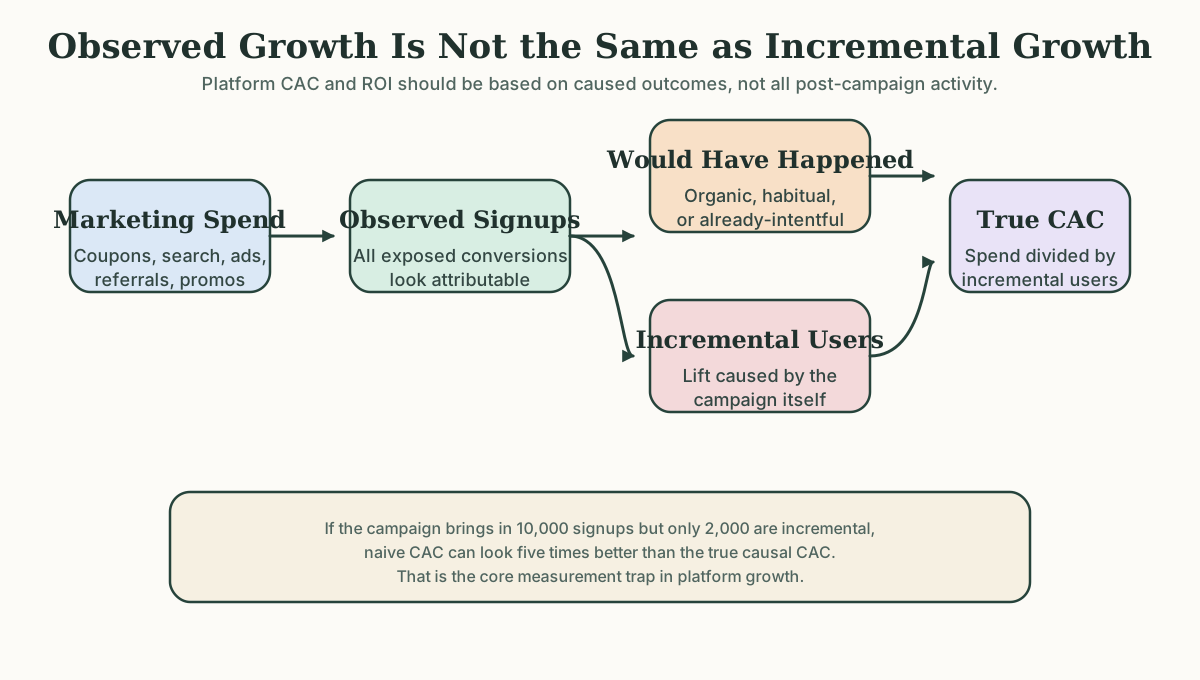
The session argues that this is frequently wrong in practice because the denominator mixes. A baseline CAC explainer 2 is a useful starting point, but the lecture’s point is that platform settings often need a stricter, incrementality-based interpretation of the same metric:
- truly incremental customers
- customers who would have arrived anyway
- customers who were merely accelerated by the campaign
The session’s stylized example is simple and powerful:
- spend
$100,000 - observe
10,000signups - experimental evidence shows only
2,000were incremental
Then:
- naive CAC =
$10 - incremental CAC =
$50
Those are radically different businesses.
4.3 Incrementality is the real marketing question
The notes repeatedly warn against attributing all post-campaign behavior to the campaign itself. That is why incrementality becomes the central concept:
- observed conversions are not the same as caused conversions
- campaign-exposed users are not a valid counterfactual for themselves
- correlation between spend and outcomes can arise from selection, timing, or pre-existing demand
The coupon example from the session is especially instructive. A superficial analysis suggested an enormous return on investment because many coupon users purchased. But once only the truly incremental redemptions were counted, the economics flipped and the campaign no longer looked attractive.
This is the right mental model for platform growth:
- not every acquired user is incremental
- not every retained user is profitable
- not every active buyer helps the seller side equally
Good platform measurement therefore asks about incremental ecosystem activity, not just top-line conversion counts.
4.4 Experiments, including multi-channel experiments, are the cleanest answer when they are feasible
The session strongly favors experimental measurement:
- randomized holdouts
- controlled tests on channels or geographies
- natural experiments when direct randomization is difficult
The eBay paid-search example is the memorable case. Shutting off branded keyword advertising revealed that much of the spend had been cannibalizing traffic that would have arrived through organic search anyway. In other words, paid clicks looked valuable in attribution dashboards because the firm was paying for users it already owned.
This is a classic platform-growth trap. Strong brands and habitual users make last-click metrics look better than reality. If a user types eBay into a search box, that user is already expressing destination intent. Paying to intercept that user on a branded keyword often does not create demand; it merely rents access to demand that already existed. The more recognizable the platform brand becomes, the more severe this mistake can get, because attribution systems continue to assign credit to the paid click even when the click added almost nothing incrementally.
The notes also discuss multi-channel experiments, especially 2 x 2 designs, to test whether channels are substitutes or complements. That extension is treated as a real design choice rather than a footnote, because platforms often run overlapping acquisition tactics whose effects are not additive.
4.5 Selection bias, endogeneity, and small-sample honesty
The sessions stress that observational marketing data are often confounded:
- high-intent users self-select into certain channels
- large spend can follow high demand rather than cause it
- campaign targeting can mirror latent value rather than generate it
This is the same logic that makes platform experimentation difficult in broader economics settings: treatment is often not randomly assigned.
The later Q and A notes add a useful managerial principle for small samples: when the data are thin, honesty is better than false precision. Use qualitative context, acknowledge uncertainty, and design the next experiment rather than pretending the current sample answers more than it does.
That is not anti-analytics. It is disciplined analytics.
4.6 Communicating analysis to decision-makers
The session includes an important applied point about executive communication. Data scientists often want to say they have “proven” a result. The lecture argues for a better approach:
- explain the counterfactual clearly
- show why the naive metric is misleading
- tell a plausible causal story backed by evidence
- connect that story to a concrete decision
This matters because platform firms often have internal incentives that resist unpleasant findings. If a marketing team is rewarded for attributed conversions, then evidence that branded search spend is mostly wasteful will face organizational resistance even when the experiment is clean.
The analytics problem and the organizational problem are therefore linked.
4.7 Guest-speaker lessons: chicken-and-egg problems and abundance mindsets
The guest-speaker material in the notes adds a grounded founder perspective. Two-sided marketplaces often face the classic chicken-and-egg problem:
- buyers want supply to be present
- suppliers want demand to be present
That is why early platform strategy often involves extreme manual effort, local focus, subsidy, or hand-built liquidity.
The discussion is especially helpful because it shows that not all early seeding looks like a direct cash subsidy. One practical approach is to seed the market with some owned inventory and treat early losses as a startup cost of creating liquidity. Another is to offer an adjacent product that one side values even before the marketplace is fully liquid:
- seed the market with some owned inventory, treating early losses as startup cost
- offer an adjacent product that one side values even before the marketplace is fully liquid
In the real-estate example, financing played that second role. It helped build the investor side of the network before the full matching problem was solved. The broader lesson is that platforms sometimes need a bridge product: something valuable enough to attract one side of the market before the full cross-side feedback loop has become self-sustaining. This also links naturally to the retailer-to-marketplace path taken by firms such as Amazon, where direct control over supply can be the staging ground for a later third-party marketplace.
The guest-speaker section also highlights how local many marketplaces really are. A city-by-city platform cannot assume that success in one geography automatically carries over to the next. Liquidity often has to be rebuilt market by market, because the buyers, sellers, and local context do not travel cleanly across locations. That is a useful corrective to overly abstract platform theory.
The guest-speaker section is also about organizational capacity as much as marketplace theory. It emphasizes:
- hiring stage-appropriate talent rather than importing executives who only know how to manage a much later-stage company
- investing early in the internal operating system of the firm, including planning rhythms, execution discipline, and coordination routines
- writing a genuine strategy narrative rather than a vague strategy slogan
There is also a financing lesson in the background. Adequate capitalization was treated not just as fuel for growth but as a way to recruit better talent, move faster, and learn faster. That matters for customer economics because better-capitalized platforms can often afford the experimentation required to discover what their true CLV and CAC really are, while under-capitalized firms may be forced into premature conclusions drawn from thin observational data.
Those points fit naturally with the measurement content in this chapter. A platform cannot interpret CLV, CAC, or incrementality well if the company itself lacks the operating discipline to act on what the measurement reveals.
The notes also emphasize an abundance mindset: build around a genuine user pain point instead of starting with the goal of “building a unicorn.” That framing fits the rest of the notes well. Customer economics become much easier to interpret when the platform is solving a real coordination problem instead of manufacturing growth theater.
4.8 The measurement lesson for platform strategy
This session expands the earlier chapters in one important way. Platform growth should not be evaluated only by:
- signups
- app installs
- attributed conversions
- gross campaign ROI
It should be evaluated by:
- retained contribution
- side-specific incrementality
- quality of acquired users
- whether acquisition deepens the network in a durable way
That is a much stricter standard, but it is closer to the economics of what platforms are actually trying to build.