2. Designing Digital Platforms
The second session turns from “why platforms can scale” to “how they are designed to make money without breaking participation.” That shift matters because a large user base is not itself a business model. Platform strategy has to specify who pays, why they pay, and how monetization interacts with network growth. The session also opened with brief housekeeping and a topic map that named the same blocks the notes follow here: digital-platform business models, revenue generation, connectivity platforms, matching-platform pricing, versioning, and data as a strategic asset.
2.1 Introduction and housekeeping: a business model is a monetization logic, not a growth slogan
The session uses a line from Michael Lewis’s The New New Thing to make an old but still relevant point: a business model is a plan for making money. During the dot-com era, firms often blurred user attention with actual monetization.
That warning still matters in platform markets because it is easy to confuse:
- user growth with economic value
- gross merchandise volume with platform revenue
- revenue with contribution margin
- short-run monetization with long-run network health
The right question is not only “How do we grow?” It is “How does the platform eventually capture part of the value it helps create?”
2.2 Digital-platform business models through the eBay and PayPal story
One of the session’s most helpful examples is the early relationship between eBay and PayPal.
The story matters for two reasons:
PayPalpiggy-backed on the activity already happening ineBayeBaybenefited from a payments layer that reduced friction and made trade easier
The rough timeline in the notes is:
PayPallaunched email-based payments in 1999- it quickly became a default payment tool inside
eBaytransactions - growth on
eBayacceleratedPayPaladoption eBayacquiredPayPalin 2002- later,
PayPal’s stand-alone value ultimately exceeded the value of the acquisition by a wide margin
This example expands the idea of network effects 2. Sometimes the valuable complement is not another user group in the same app but an adjacent service that makes the platform more usable. Payments, logistics, identity, and analytics can all play that role.
The operational details make the strategic point much clearer. Early eBay transactions were often settled with checks, money orders, and escrow-like workarounds that now feel almost pre-platform. The marketplace itself could create a match, but the payment layer still imposed delay, uncertainty, and administrative friction. eBay even billed sellers after completed transactions and depended on mailed checks for fee collection, which is a vivid reminder that a platform can be technologically important while remaining operationally clumsy.
PayPal mattered because it addressed that bottleneck. It gave sellers a way to process many small transactions more smoothly, gave buyers a more standardized payment experience, and gradually reduced the messy off-platform settlement that had constrained marketplace liquidity. But the adjustment was not immediate. For years, the integration remained awkward enough that eBay buyers were still navigating a much more cumbersome checkout flow than Amazon shoppers. That gap matters. A complementary service only deepens network effects if users actually experience it as a reduction in friction rather than as another window, login, or handoff in the process.
That is why the eBay-PayPal example is not merely an acquisition story. It is a lesson in platform execution. A good platform design identifies which adjacent service is most binding for growth, but a great platform design also integrates that service tightly enough that the whole transaction becomes easier, faster, and more trustworthy.
2.3 Revenue generation: pricing, demand, and elasticity
The session uses a step-function view of willingness to pay to build intuition about demand:
- rank users from highest willingness to pay to lowest
- stack them cumulatively
- the resulting curve slopes downward because later users are less willing to pay
That framing is useful because it links product thinking and economics cleanly:
- a better product can shift the willingness-to-pay distribution upward
- stronger network effects can flatten the quantity drop from a given price increase
- better targeting or versioning can extract more surplus without charging everyone the same price
The notes discuss a simple revenue comparison across prices such as $500, $600, and $700 to show that revenue is price times quantity and therefore does not rise mechanically with price. The “right” price depends on how participation responds.
In platform markets, that logic gets more complicated because participation on one side changes value on the other side.
2.4 Elasticity is ecosystem-wide in two-sided markets
The session introduces price elasticity and cross-side elasticity as preparation for marketplace pricing. That move is essential. In a one-sided product, the main question is how buyers respond to price. In a two-sided platform, changing price on one side can alter:
- participation on that side
- network value on the opposite side
- monetization opportunities elsewhere in the stack
So the platform does not simply ask, “Who can we charge?” It asks:
- which side is more price sensitive?
- which side unlocks activity on the other side?
- how much should we subsidize one side to grow the total network?
This is why many marketplaces charge sellers, merchants, or advertisers much more aggressively than end users.
2.5 Connectivity platforms: advertising versus freemium
The session contrasts two common models for social, messaging, and community products.
Advertising model:
- users get free access
- advertisers become the paying customer class
- the platform monetizes attention and targeting
Freemium model:
- a free tier preserves network growth
- a smaller set of users pays for premium quality, status, convenience, or functionality
The Discord example is especially useful. The notes explain that Discord avoided a heavy advertising model because interest-based communities rely on trust, shared identity, and conversational quality. A premium tier for enhanced quality fit the product better than an ad-heavy experience that could have degraded community trust. That sits squarely inside the broader freemium model 3.
The Napster example points to another idea: even platforms that fail legally or operationally can still have monetizable user bases if engagement is unusually sticky. The notes mention that Napster’s users retained substantial value despite the service’s collapse.
The design lesson is not that one model is always superior. It is that monetization must match the social logic of the product.
2.6 Matching (two-sided) platforms and pricing
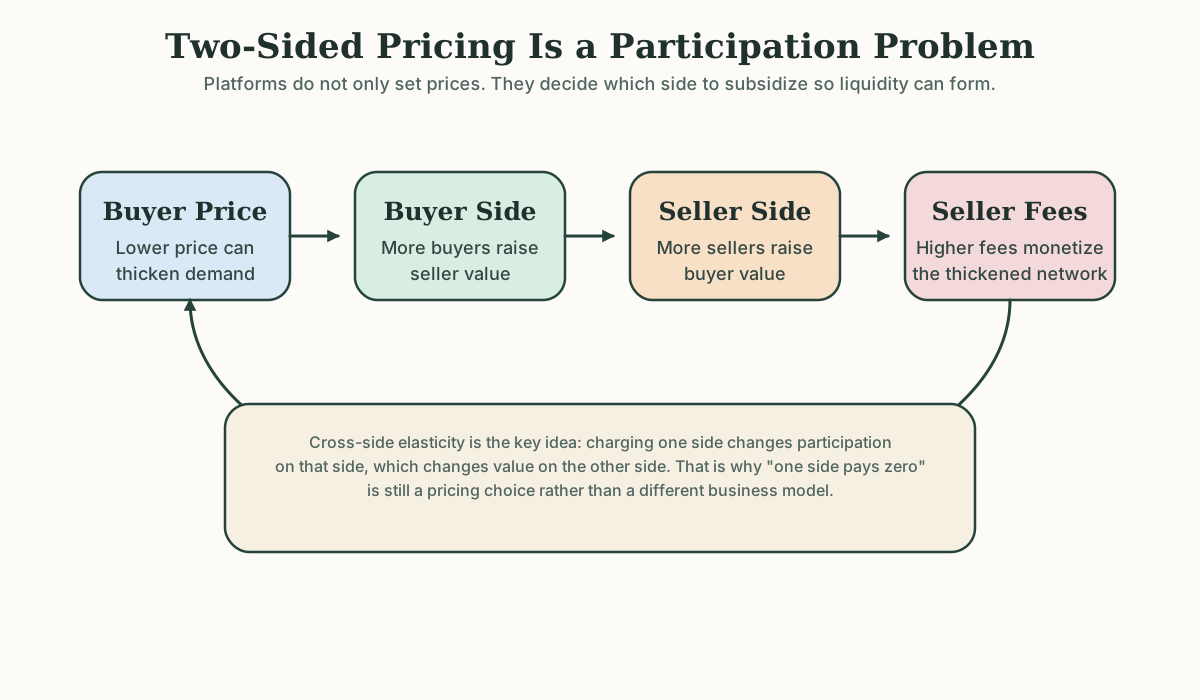
In marketplaces, the lecture emphasizes that “one side pays everything” and “both sides pay something” are not fundamentally different business models. Setting one side’s price to zero is just an extreme point on a pricing schedule.
Examples from the notes:
eBay,Uber, andEtsyoften lean toward charging the supply side moreAirbnbandGrubhubcan split fees across both sides
The underlying decision rule is comparative elasticity. If buyers are more price sensitive than sellers, subsidizing buyers can be rational because more buyer participation increases seller value and overall liquidity.
That same logic explains the two-sided pricing flywheel:
- price on the buyer side affects buyer participation
- price on the seller side affects seller participation
- the participation levels affect each other through network effects
- the platform can then re-optimize pricing once the network thickens
Pricing is therefore part economics, part sequencing problem.
2.7 Versioning and price discrimination
The session treats versioning as a general pricing architecture rather than a narrow premium-upgrade trick. A concise explainer on price versioning 4 uses the same broader idea. Versioning can include:
- quality-ranked versions, such as better audio or premium features
- quantity discounts for high-volume sellers
- subscription memberships for frequent users
- value-added services layered on top of the core marketplace
The specific examples in the notes are worth preserving:
Discordand dating apps sell better quality or additional featureseBay StoresandAmazon Professional Sellerstyle plans create seller tiersUber Pass-like memberships reward heavy users- value-added operational services create monetization beyond the basic take rate
This is where the session becomes especially important for modern platform strategy. Many durable platforms do not earn from a single commission line. They build a revenue stack.
2.8 Value-added services as a second layer of platform economics
The notes highlight DoorDash and Amazon as strong examples of how marketplaces deepen monetization:
DoorDashoffers kitchens, dashboards, and operating supportAmazonoffers fulfillment, lending, seller tooling, and analytics
These services matter for more than revenue. They can:
- reduce supplier-side friction
- improve reliability and customer experience
- make sellers more dependent on the platform’s operational infrastructure
- turn platform data into new products
They also change the competitive position of the platform. A simple intermediary can often be multi-homed around, but a platform that becomes the place where sellers store inventory, finance purchases, buy ads, and manage operations becomes much harder to leave. That is why value-added services are often best understood as both monetization tools and moat-building tools.
This is an important extension of the session. Platform design is often about deciding when to remain a neutral intermediary and when to become an infrastructure provider to one side of the market.
2.9 Knowing your customer, data as a strategic asset, and advertising trade-offs
The session closes by stressing customer understanding and data use. This is the “knowing your customer” part of the notes, and it sits next to an explicit warning about advertising revenue and its trade-offs. Because platforms mediate interaction, they observe:
- search and browsing behavior
- transaction patterns
- conversion funnels
- willingness-to-pay proxies
- quality failures and pain points
That data can improve:
- matching and ranking
- ad targeting
- product design
- versioning choices
- value-added service development
The notes also make an important ad-market point. Advertising works especially well when a platform has large scale and rich behavioral data, but ads can also damage experience and trust if the balance is wrong. That is why some platforms prefer to monetize a subset of users directly rather than maximize advertising load.
The practical lesson from this session is that platform monetization is not a single decision. It is a system of choices about subsidy, trust, versioning, and what additional layers of service the platform should own.