1. Network Effects and Economies of Scale
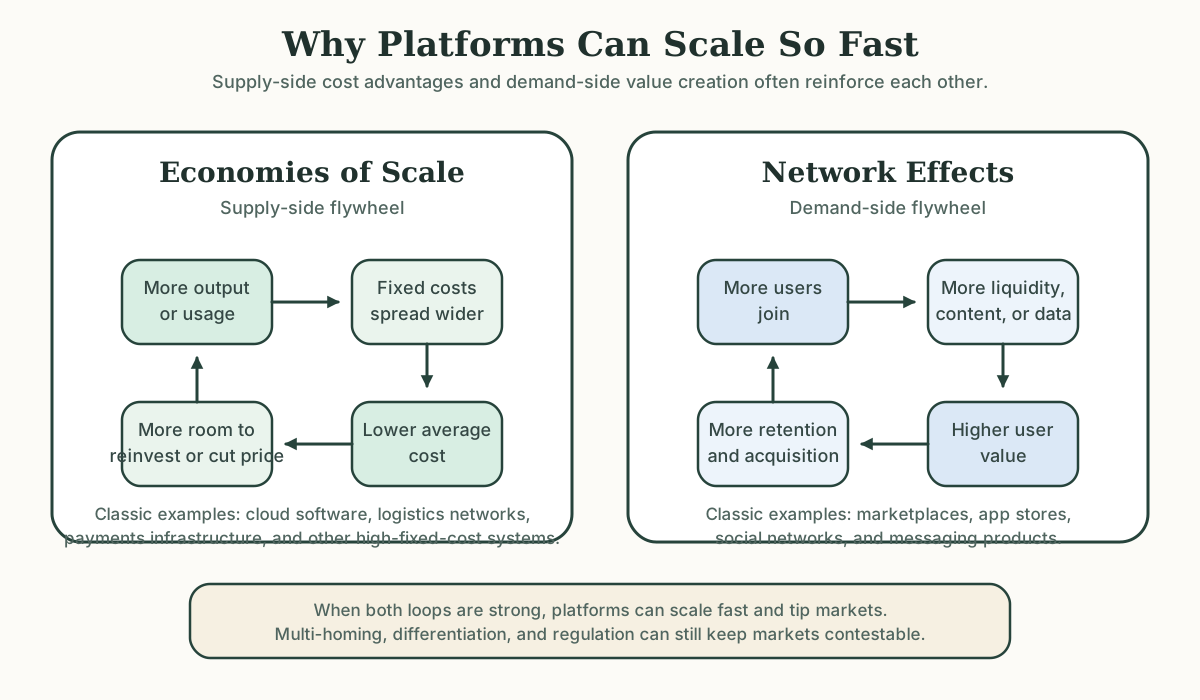
The opening session sets up the core distinction that the rest of the notes keep returning to: some advantages are supply-side and some are demand-side. Digital platforms often combine both, but they are not the same mechanism and they imply different strategic choices.
1.1 Orientation & cohort: why the distinction matters
The original session opened with a cohort-oriented introduction and emphasized that participants came from product, strategy, marketing, and technical roles across industries and company sizes. That framing is useful because platform economics is one of those topics where the same concept needs to work for founders, operators, economists, and data scientists at the same time.
The session’s central move was to separate three questions that are often blurred together:
- does a larger platform have lower cost per unit?
- does a larger platform create more value for users?
- does larger size necessarily imply eventual monopoly?
Those questions map to economies of scale, network effects, and market tipping. Treating them as interchangeable leads to sloppy analysis.
1.2 Costs and scale
An industry with no meaningful scale economies stays fragmented more easily. If firms cannot spread fixed cost over larger output, growing demand simply supports more firms rather than dramatically advantaging a single larger one.
By contrast, an industry with strong scale economies can favor concentration because average cost falls as output rises. Utilities and railways are the standard textbook examples: the large fixed-cost base makes size itself a production advantage.
That logic carries into parts of the digital economy too:
- software has high upfront build cost but low marginal replication cost
- cloud infrastructure, data pipelines, and brand investments can be spread over a larger user base
- operational systems such as payments, seller tooling, and logistics often get cheaper per transaction as volume grows
The key point is that scale economies do not require user-to-user interaction. They come from the production side.
1.3 Network effects: definitions and types
Network effects appear when the value to one user depends on how many other users are present. The telephone network remains the classic example: each additional user increases the number of people everyone else can reach. General overviews 2 3 line up closely with the distinction used in the lecture.
The session distinguishes two main forms:
- direct or same-side network effects: the same user group benefits from growth on its own side, as in messaging apps and many social networks
- indirect or cross-side network effects: one side benefits when a complementary side grows, as in buyers and sellers, riders and drivers, app users and developers
This distinction matters because the growth tactics are different. A messaging product needs enough density within a user’s social graph. A marketplace needs enough supply and demand simultaneously.
The session also notes that network effects are not automatically positive forever. Congestion, ad overload, spam, and poor-quality supply can turn growth into lower utility. That is the first hint that platform design and trust systems matter, which becomes central later in the notes.
Operating systems provide another useful illustration because they show that network effects do not have to look like overt social-media virality in order to matter economically. Windows historically benefited not only from lower-cost hardware and a more open device ecosystem, but also from compatibility. When more schools, offices, and households use the same operating system, the surrounding environment begins to standardize around it:
- files are easier to exchange
- more software developers build for the dominant installed base
- more peripheral makers and enterprise IT systems optimize around the same environment
- workers and students learn habits that are easier to carry into the next workplace
That is a genuine demand-side advantage because each additional adopter strengthens the value of the broader ecosystem for everyone else. It also helps explain why outcomes can diverge across regions. In lower-income markets, cheaper compatible hardware and wider software availability can reinforce one another until the installed base becomes self-sustaining. The lesson is that network effects can operate through coordination and complementarity, not only through direct social interaction.
1.4 Strength of network effects
The notes highlight several conditions that make network effects more powerful:
- broad geographic coverage matters, as in ATM networks or ride-sharing platforms
- repeat users value variety, as in streaming video, gaming, or marketplaces with large catalogs
- good matching requires thick participation on both sides, as in labor markets, logistics exchanges, or dating platforms
Each of those cases has the same structure: a thicker network improves the odds of a successful match or a more satisfying experience. When that happens, growth can generate a genuine positive feedback loop:
- more participants increase value
- higher value attracts more participants
- the platform becomes harder to dislodge
That loop is powerful, but it is not magic. The loop can stall if onboarding is poor, matching quality is low, or users can easily take part in several competing networks.
1.5 Economies of networks and scale
The lecture’s most important strategic observation is that many digital platforms benefit from both falling average cost and rising average value:
- more usage spreads fixed engineering and operational cost
- more usage also improves liquidity, content depth, or data quality
That combination is what makes platform businesses feel structurally different from ordinary linear firms. A larger installed base can improve the economics of serving the next user and improve the product that next user experiences.
This is why the same firm can simultaneously talk about:
- better user experience because the network is larger
- better margins because the cost base is spread more widely
Those are different channels, and strong platform strategy usually depends on understanding both.
Amazon’s well-known flywheel is a clean example of how the two channels interact. More buyers make the marketplace more attractive to sellers. More sellers improve variety, availability, and price competition for buyers. Higher marketplace activity then justifies larger investments in fulfillment centers, software, and logistics coordination. Those investments lower average cost and improve reliability, which attracts still more buyers. Once the loop is written out in full, it becomes clear why platform strategy is often so hard to imitate: a rival may need to match both the network thickness and the operational scale at the same time.
1.6 Winner-take-all versus multi-homing
The notes are careful not to overstate tipping dynamics. Dominance becomes more likely when:
- network effects are strong
- products are not highly differentiated
- users are relatively indifferent across alternatives
- multi-homing is expensive or inconvenient
- data, identity, or reputation are difficult to port
But those conditions are often only partly true in real platform markets. Multi-homing weakens exclusivity. If buyers check several apps, sellers cross-list, or users maintain accounts on multiple networks, then network effects no longer force a single equilibrium as strongly.
That is why many platform markets sustain more than one important player:
- riders compare
UberandLyft - people use
WhatsApp,iMessage,Messenger, or Slack-like tools for different contexts - sellers list across several marketplaces
The takeaway is subtle but important: network effects raise the odds of concentration, but they do not remove the need for differentiated product design, stronger tools, or better trust and retention.
1.7 Matching (two-sided) platforms
Matching platforms deserve their own treatment because they are the form of platform most people have in mind when they talk about digital-platform economics. They are also the easiest place to confuse scale with network value, because the platform does not simply produce output more cheaply as it grows. It improves the probability, speed, and quality of a match.
A matching platform connects groups that hold complementary resources or needs:
- buyers and sellers in e-commerce
- riders and drivers in ride-sharing
- shippers and truckers in logistics
- people seeking jobs and employers
- individuals seeking partners in dating markets
Indirect network effects are the central mechanism. More participation on one side improves the expected value for the other side because it raises the odds of a useful match, shortens waiting time, improves variety, or thickens liquidity. A marketplace-focused explainer is helpful on exactly this intuition 4.
The notes also emphasize familiar examples:
AmazoneBayCraigslistEtsy- ride-sharing platforms
This is also where the “Uber for X” pattern shows up. Founders often try to transplant matching-platform logic into new verticals, but success depends on whether the market truly has a coordination problem, whether enough participation can be concentrated locally, and whether users actually care about thick liquidity.
1.8 Case studies and examples from the session
The examples in the notes are useful because they show where the simple story breaks.
MySpace versus Facebook:
- both benefited from direct network effects
- yet superior user experience, cleaner execution, and better retention still mattered
- early lead was not enough for MySpace to lock in the market
Etsy versus eBay:
eBaywas huge and broadEtsywon traction through specialization, community, and a more appropriate product for handmade and vintage goods- heterogeneous preferences made a niche platform viable even in the presence of a giant
Messaging and ride-sharing coexistence:
- low switching and multi-homing costs weaken winner-take-all pressure
- users do not always want one universal network for every use case
- differentiation can matter as much as raw scale
Amazon versus eBay:
Amazon’s flywheel was built around buyer experience and what the company called customer obsession- more buyer traffic attracted more sellers, which improved variety and sharpened the indirect network effect
eBay, by contrast, historically oriented more strongly toward sellers because sellers paid the fees and were treated as the immediate business customers- that contrast shows how network effects can still be weakened when a platform optimizes too narrowly for the side that pays today rather than the side that determines long-run marketplace trust and demand
- even a platform with strong indirect network effects can underperform if it treats marketplace design as fee extraction instead of demand creation
Craigslist and local liquidity:
Craigslistis a reminder that matching power can come from local liquidity rather than from product sophistication- one broad platform later fragmented into vertical specialists, which is a reminder that sub-networks can peel off from a generalist incumbent
- local matching markets also show why a platform can remain durable without turning into a universal global winner: what matters is thickness where users actually need the match
- this matters especially in labor, housing, dating, and local resale markets, where a platform can dominate a specific locality or use case without controlling the whole category everywhere
These examples are a healthy corrective to simplistic “network effects = monopoly” thinking.
1.9 Key takeaways and working diagnostic
When reading any platform market, it helps to ask:
- What part of the advantage comes from lower cost at scale?
- What part comes from higher user value at scale?
- Where can users or suppliers multi-home?
- What preferences or features keep the market segmented?
Those four questions set up almost everything that follows in later chapters.