3. Trust in Online Markets
The trust session adds a crucial correction to growth-centric platform thinking: network effects are not enough if participants expect cheating, low quality, or manipulation. In anonymous digital markets, trust is an economic input.
3.1 DoorDash Kitchens as a case about cross-side value
The session opens with DoorDash Kitchens, the shared-kitchen or ghost-kitchen initiative in Redwood City and San Jose. The example matters because it sits at the intersection of infrastructure, network effects, and trust.
The basic idea is:
- more restaurants in the facility create more variety for diners
- more diner demand makes the facility more attractive to restaurants
- operational infrastructure lowers the cost of expansion for participating restaurants
That is not just a scale story. It is an indirect network-effect story. The service becomes more valuable to each side as the complementary side deepens.
The comparison to Amazon FBA is also helpful. Warehousing and fulfillment are operational services, but they strengthen marketplace participation by making the whole transaction more reliable and more scalable.
3.2 The trust problem in one-shot digital exchange
The core conceptual device in the session is a simple trust game:
- buyer decides whether to transact
- seller decides whether to honor the transaction or cheat
In a one-shot game with asymmetric information, the seller may have an incentive to cheat after receiving payment. Anticipating that, the buyer may refuse to transact in the first place. The result is inefficient non-exchange even when both sides could be better off under cooperation.
This is why trust is not a soft culture topic in platform economics. It is part of what determines whether the market clears at all.
The session’s deeper point is that online platforms often recreate the conditions of trade among strangers:
- little prior relationship
- incomplete information
- potentially weak legal recourse
- lots of first-time interactions
So the platform has to build substitute institutions.
3.3 Historical institutions and the Maghribi traders help explain modern design
The notes reference Avner Greif’s work on medieval Mediterranean trade and the Maghribi traders. The historical lesson is not that digital platforms resemble medieval guilds literally. It is that trust can emerge when a community develops:
- reputation mechanisms
- repeated interaction
- sanctions for misconduct
- reliable information flows
Where legal enforcement is weak or too slow, these institutions allow exchange to happen anyway.
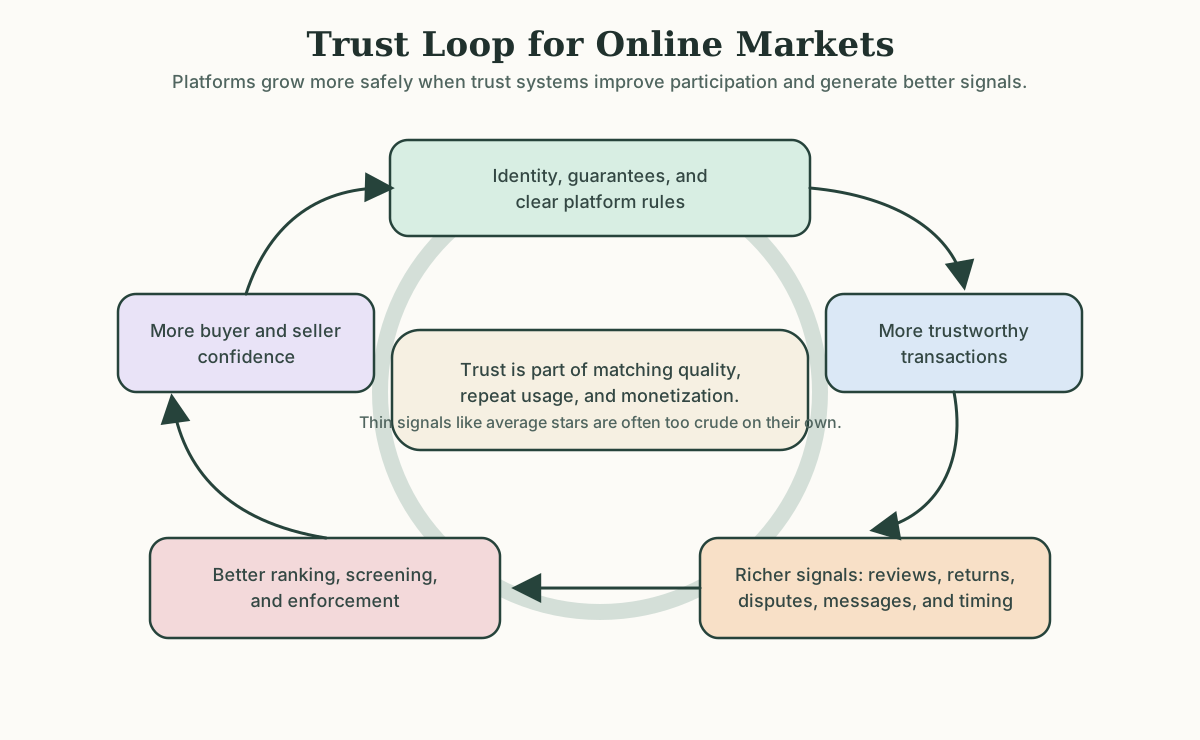
Platforms are modern institution-builders in exactly that sense. Ratings, identity verification, fraud models, refund guarantees, and dispute resolution are digital substitutes for the informal and communal enforcement systems that earlier trade networks relied upon.
3.4 eBay’s feedback system shows both the power and the limits of reputation
eBay is the session’s main case study. A guide to seller feedback mechanics 2 is helpful for the concrete structure described here. The basic public feedback system is simple:
- positive feedback adds to a seller’s score
- negative feedback subtracts from it
- detailed seller ratings break performance into additional dimensions such as shipping, communication, and item accuracy
The surprising empirical result in the notes is that seller reputation scores are extremely compressed. Median positive feedback is effectively perfect, the mean is around 99.3%, and even lower percentiles remain very high.
The compression problem becomes even more striking once the base rate of visible punishment is stated directly. Outright negative feedback showed up in only about 0.4% of transactions in one large eBay sample. When visible punishment is that rare, public ratings can look reassuring while hiding a great deal of unresolved variation in transaction quality. In practical terms, the badge still looks informative, but its informational content has been squeezed into an extremely narrow range.
That creates an information problem:
- if almost everyone looks excellent, buyers cannot distinguish high-quality sellers from merely adequate ones
- public reputation becomes less informative than its simplicity suggests
The session uses this to ask whether the platform is seeing:
- selection, where weak sellers exit and only strong ones remain
- or bias, where negative reviews are systematically underreported
The answer is probably a mix of both.
3.5 Feedback systems are vulnerable to reciprocity and retaliation
The notes point to a subtle but important design failure: buyers may delay or suppress negative feedback if they fear seller retaliation. That means public ratings can become strategically distorted.
This matters beyond eBay. In lodging, ride-sharing, freelance work, and peer-to-peer commerce, both sides may worry about retaliation or social friction.
The broader lesson is that reputation systems must be designed to elicit honest information, not simply display submitted ratings. That is why platforms often move toward:
- simultaneous review release
- delayed publication
- two-sided blind review windows
- stronger private enforcement signals behind the scenes
Without those design choices, the reputation layer can look healthy while conveying very little real information.
3.6 Effect of reputation on buyer behavior
One of the more interesting observations in the course is about the effect of reputation on buyer behavior: buyers who purchased from sellers with a perfect 100% positive-feedback score were reportedly less likely to return to eBay than buyers who purchased from sellers with slightly lower scores.
The notes suggest at least two plausible explanations:
- selection bias, where experienced buyers may choose less-established sellers for price or niche reasons
- reputation compression, where a near-perfect score no longer differentiates seller quality meaningfully
A third interpretation is also economically useful. The buyers most likely to insist on a perfect score may be exactly the buyers who are least inclined to trust the platform in the first place. They enter cautiously, choose the safest-looking visible option, and then leave after a single purchase regardless of how the transaction goes. If that is true, the public score is not merely failing to predict quality. It is partly capturing buyer anxiety and one-time behavior.
This is an important extension of the trust argument. A reputation system can look reassuring while conveying almost no marginal information. That is exactly when platforms need richer internal signals instead of relying on the visible headline metric.
3.7 Data-driven improvements: better trust systems use operational data, not only star ratings
One of the best parts of the session is the move from visible ratings to richer inferred trust signals. The notes describe eBay experiments that used:
- returns
- disputes
- low detailed seller ratings
- transaction messages and unstructured text
- broader patterns of buyer satisfaction
An A/B test that weighted predicted feedback rather than only simple historical percent-positive scores improved repeat purchasing. That is a major platform-design insight: trust can be improved through ranking models, not just policy language.
What makes that move so important is that operational data often reveal disappointment earlier than formal reviews do. A tense message exchange, a return request, or a shipping complaint may be a much better signal of trust failure than a public star rating that never gets submitted. Once that is understood, the trust problem starts to look less like a review-interface problem and more like an inference problem over many weak signals.
Public reputation and internal trust prediction are related but not identical.
Internal trust models can answer questions like:
- which transaction is most likely to disappoint the buyer?
- which seller is generating subtle but recurring service failures?
- which reviews are more credible because of reviewer quality and behavior?
Those are ranking and causal-inference problems as much as policy problems.
3.8 Trust design patterns that platforms repeatedly rediscover
The session implies a practical design toolkit:
- identity and payment verification
- clear consequence systems for abuse and low quality
- refund and guarantee mechanisms that lower perceived downside risk
- fraud models that combine behavior, content, and historical outcomes
- ranking systems that demote unreliable suppliers before users explicitly complain
- review-system designs that minimize retaliation
Trust is therefore not separate from the marketplace algorithm. It shapes search ranking, supplier visibility, matching quality, and long-run retention.
3.9 Trust is the bridge between network effects and durable growth
If Chapter 1 explains how platforms grow and Chapter 2 explains how they monetize, this chapter explains why both can fail.
Without trust:
- buyers transact less
- sellers invest less in quality
- cross-side network effects weaken
- customer acquisition becomes more expensive because retention falls
With trust:
- more first transactions happen
- more repeat transactions happen
- quality improves because incentives become clearer
- the platform can rely less on blanket subsidy and more on durable reputation
That is why trust belongs at the center of platform economics rather than at the edge of operations.