1. Why Recommender Systems Matter
Recommender systems help users navigate very large item catalogs (videos, products, courses, jobs, music) by ranking items likely to be relevant to each user. See the background overview in Wikipedia: Recommender system.
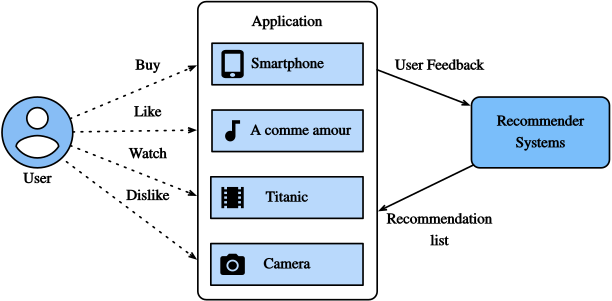
Image credit: Dive into Deep Learning, CC BY-SA 4.0.
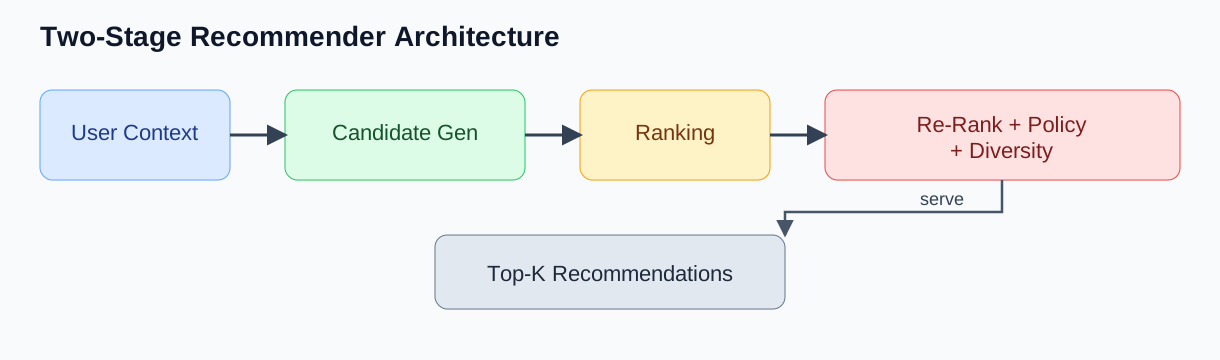
For data scientists, this is usually not a pure prediction task. It is a ranking and decision problem with constraints:
- Relevance and personalization
- Diversity and novelty
- Latency and serving cost
- Business goals (retention, conversion, long-term value)
1.1 Common applications
- E-commerce and retail: cross-sell, upsell, “complete the look”, and basket expansion
- Media and entertainment: personalized ranking of video, music, articles, and ads
- Banking and financial services: product recommendations, offers, and next-best action
1.2 Business value
- Helps users discover items they would not have found through search alone
- Increases engagement, session depth, and content consumption
- Improves conversion, basket size, and retention when recommendations are well-targeted
Google’s recommender course also makes a useful product distinction between two common surfaces:
- Homepage recommendations, where the query is the user or session context
- Related-item recommendations, where the query is the current item being viewed
That distinction matters because homepage recommendation usually starts from a user or context embedding, while related-item recommendation often starts from the item embedding itself and retrieves nearby items in embedding space.