4. Feature Engineering and Representation
Feature engineering is often where the biggest gains in tabular ML come from. Better features can make simple models much stronger and make complex models easier to train well.
Learning goals
- distinguish feature selection, construction, and extraction
- represent categorical and text data in model-friendly ways
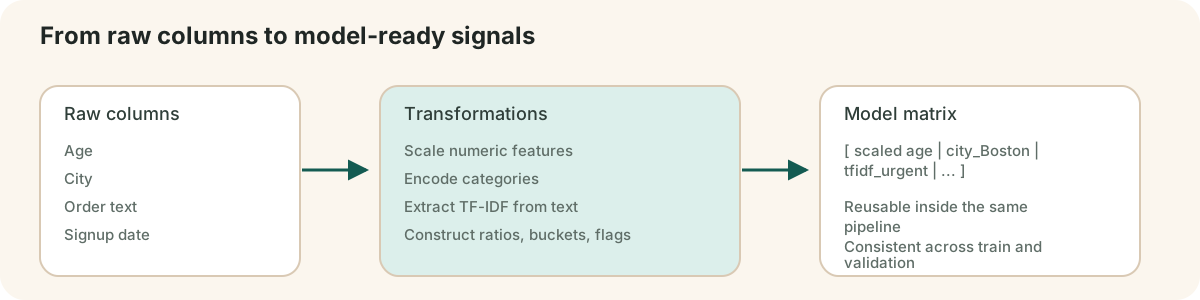
- think about features as a modeling language rather than just raw columns
Three useful categories
Feature engineering usually falls into three broad buckets:
- feature selection: keep the most useful signals and remove distracting ones
- feature construction: build new variables from existing ones
- feature extraction: transform raw data into a more model-friendly representation
Examples:
- interaction terms between price and discount
- ratios such as revenue per active user
- grouped age bands or tenure buckets
- one-hot encoded category indicators
| Column pattern | Useful transformation | Why it helps | Main caution |
|---|---|---|---|
| nominal category | one-hot or grouped encoding | avoids fake numeric order | can explode dimensionality |
| ordered category | ordinal encoding | preserves meaningful order | only valid when order is real |
| sparse text field | counts or TF-IDF | turns words into structured signals | easy to leak labels through vocabulary choices |
| skewed numeric variable | log, bucket, or winsorized transform | stabilizes scale and outliers | can make interpretation less direct |
Categorical variables
Many tabular datasets contain categories with no natural numeric meaning. A model still needs them represented numerically.
Useful options include:
- ordinal encoding when categories have a meaningful order
- one-hot encoding when categories are nominal and order should not be implied
- grouped or hierarchical encoding when categories are too numerous or too sparse
- target-based encodings when used carefully and with leakage awareness
The main caution is simple: numeric codes can accidentally imply rank or distance where none exists.
For a nominal category
High-cardinality features
Some categorical variables, such as zip codes, product IDs, or job titles, can explode the feature space if encoded naively.
In those cases, common strategies include:
- grouping rare categories
- mapping to a hierarchy
- replacing values with a signal that reflects the target or behavior pattern
There is no universal rule. The right approach depends on whether the category is mostly identity, geography, behavior, or something else.
Text as a tabular feature
Text fields often appear inside otherwise tabular datasets: product titles, support messages, free-form descriptions, comments, notes.
A practical preprocessing path is:
- clean obvious formatting issues
- tokenize text into units
- remove or keep stop words based on the task
- optionally stem or normalize
- vectorize with counts or TF-IDF
This turns free-form text into structured numeric features that can join the rest of the table.
A common TF-IDF scoring pattern is:
Representation choices affect models
Feature engineering is not model-agnostic.
- linear models benefit from thoughtful transformations and explicit interactions
- distance-based models are sensitive to scale and sparsity
- tree-based models often tolerate raw nonlinear relationships better
This is why feature engineering and model choice should be treated as a coupled design decision.
Practical heuristic
Before inventing many new features, ask:
- What would a skilled human use to make this prediction?
- What information is visible at prediction time?
- What transformation would make the relevant pattern easier for the model to detect?
Those questions often lead to better features than blindly generating large numbers of them.
Chapter takeaway
Raw data is rarely the best language for a model. Feature engineering translates the problem into a form the model can actually use.
Practice
Take one dataset and list:
- two raw columns you would keep as-is
- two columns you would transform
- one new feature you would construct from domain intuition
Then move to Tree-Based Models and Tuning.