5. Boosting and Modern Tree Libraries
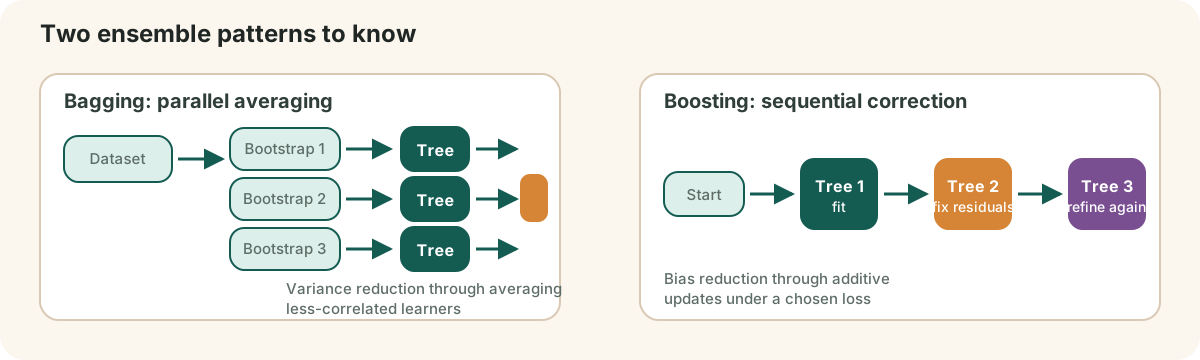
Bagging and random forests reduce variance by averaging trees trained in parallel. Boosting takes a different path: build learners sequentially so that later learners focus on what earlier learners still get wrong.
Learning goals
- understand the basic motivation behind boosting
- connect boosting to loss minimization and weak learners
- compare XGBoost, LightGBM, and CatBoost at a practical level
Why boosting exists
Random forests are powerful, but they mainly help with variance. Boosting is motivated by a complementary goal:
- can we reduce bias while keeping variance under control?
That makes boosting especially appealing when a single tree or even a bagged ensemble is still not expressive enough.
Weak learners
Boosting is usually built around weak learners:
- shallow trees
- short trees with limited node count
- learners that are individually biased but still better than trivial guessing
The point is not that a stump is magical. The point is that many modest learners can become a strong system when fit in the right sequence.
Loss functions matter
Boosting methods are tightly tied to the loss they optimize.
For regression, common examples are:
- mean squared error
- mean absolute error
- Huber loss
For classification, common examples include:
- logistic or deviance-style loss
- exponential loss, as in AdaBoost
- hinge-style losses in related margin methods
This is why boosting is easier to understand when you connect it to objective functions rather than just “many small trees.”
Gradient boosting intuition
Gradient boosting can be read as:
- fit a model
- measure what the model still gets wrong under a loss
- fit the next learner to improve those residual or gradient-like errors
- repeat carefully
This creates a powerful additive model, but it also means boosting can overfit if the learning rate, depth, and number of rounds are not controlled.
The stagewise update is often written as:
and in gradient boosting,
XGBoost
XGBoost became influential because it combined strong boosting performance with serious systems engineering.
Important ideas include:
- scalable tree boosting
- approximate greedy split finding
- optimized memory and computation strategies
It is still one of the most standard and dependable libraries for boosted trees.
LightGBM
LightGBM emphasizes efficiency and scale.
Two well-known design ideas are:
- Gradient-based One-Side Sampling (GOSS)
- Exclusive Feature Bundling (EFB)
These choices make LightGBM especially appealing when data is large or features are sparse.
CatBoost
CatBoost is especially notable for categorical data handling and its ordering principle.
Two recurring ideas are:
- target encoding done with leakage-aware ordering logic
- ordered boosting to reduce target leakage and prediction shift during training
This makes CatBoost a very important library to know whenever categorical structure is central to the problem.
| Library | Distinguishing idea | Typical strength | Watch-out |
|---|---|---|---|
| XGBoost | highly optimized scalable boosting with strong regularization controls | dependable general-purpose baseline | can invite very large search spaces |
| LightGBM | histogram-based training, GOSS, and EFB | speed and scale on large or sparse data | categorical handling often needs more care than CatBoost |
| CatBoost | ordered statistics and categorical-feature handling | strong default when categories matter | slower than LightGBM on some very large setups |
Practical comparison mindset
A useful rough intuition is:
- XGBoost: widely adopted, strong default, general-purpose
- LightGBM: fast, scalable, often attractive for large or sparse problems
- CatBoost: especially compelling when categorical variables are important
These are not rigid rules. The real lesson is to compare them on your data rather than rely on brand-level assumptions.
Practical workflow
A healthy comparison set in a tree-focused project might include:
- a regularized single tree
- a random forest or ExtraTrees baseline
- one or more boosted-tree libraries
That comparison usually teaches more than jumping directly to the most complex option.
Chapter takeaway
Boosting expands the tree-based toolkit from variance reduction into bias reduction, and the major libraries differ in both algorithmic design and practical ergonomics.
Practice
For one dataset you care about, decide:
- When would you begin with random forests?
- When would you move to boosting?
- Which of XGBoost, LightGBM, or CatBoost would you test first, and why?